
We love pumping tons of promising new users into our clients’ databases. Great user acquisition campaigns do more than add volume; they find high-quality users, increase the odds of those users opting in, collect enough valuable data to effectively personalize follow-up emails, and establish preliminary campaign goals and KPIs to use for future optimization roadmaps.
Before I get into the details, a bit of a flex: DMi manages database acquisition programs for over hundreds of brands at some of the world’s largest CPG companies. Our brand portfolio has acquired over 54 million net new email opt-ins for our clients’ databases, with an average first 30-day active rate of 47%. Using this active rate to back into an effective cost per active lead, our brands enjoy 50% lower costs per active lead than the average brands pay for active leads on other paid channels, like Facebook Ads.
Successful user acquisition starts with campaign setup. For this post, I’ll break down our setup into four parts: targeting, opt-in presentation, custom questions, and post-acquisition goal definition.
Let’s take a closer look at DMi’s approach to each.
Strategic targeting
Assuming the brand knows its target customer, the first thing we feed our acquisition partners is demographic targeting – e.g. the age, gender, location, etc. of the users we’re looking to acquire.
Targeting can take two forms: filtering and straight-up targeting. With the filter set-up, we collect only subscribers who are included in the client’s targeting parameters (note: dictating this uniformly high lead quality will likely raise the Cost Per Lead). With the targeting setup, we provide the targeting parameters to our publisher partners, who layer those parameters into their targeting to restrict the users who will be shown your opt-in message. It’s important to note that targeting is less iron-clad than filtering (you’ll get users who aren’t strictly within your parameters).
Where possible, we prefer leaning into targeting and opt-in copy to attract the right audience to self-select and opt in to your brand communications. This could mean targeting parents, specific zip codes, etc. It’s especially good to do if you’ve already got a high-performing email series relevant to that specific audience.
Once our client’s target audiences are established, we set up separate campaigns for each audience and dedicate specific budgets to each target market.
How to present the opt-in
Getting in front of the right users is a big first step; an equally big second step is enticing those users to opt into communications for your brand.
First, make your opt-in offer an enticing one – and double-confirm that the offer will be relayed in your first email. For instance, if your opt-in language includes a 25% off coupon, the first email those new subscribers receive must include a clearly accessible 25% off coupon.
Second, keep the fields for information you collect short and simple – limit those fields to information you’ll use for more targeted marketing efforts. For instance, if you’re asking whether the user is a parent, use that information to add the user to a segment that receives relevant content about parenting.

Custom questions in the opt-in process: to use or not to use?
Just as your opt-in form should stick only to fields that help tailor subsequent content, we recommend that you only add custom questions that will help you better customize content for each audience. (Note: Some publisher partners do not have the ability to ask custom questions, which limits our ability to diversify the publisher mix.)
Here’s an example of custom questions:
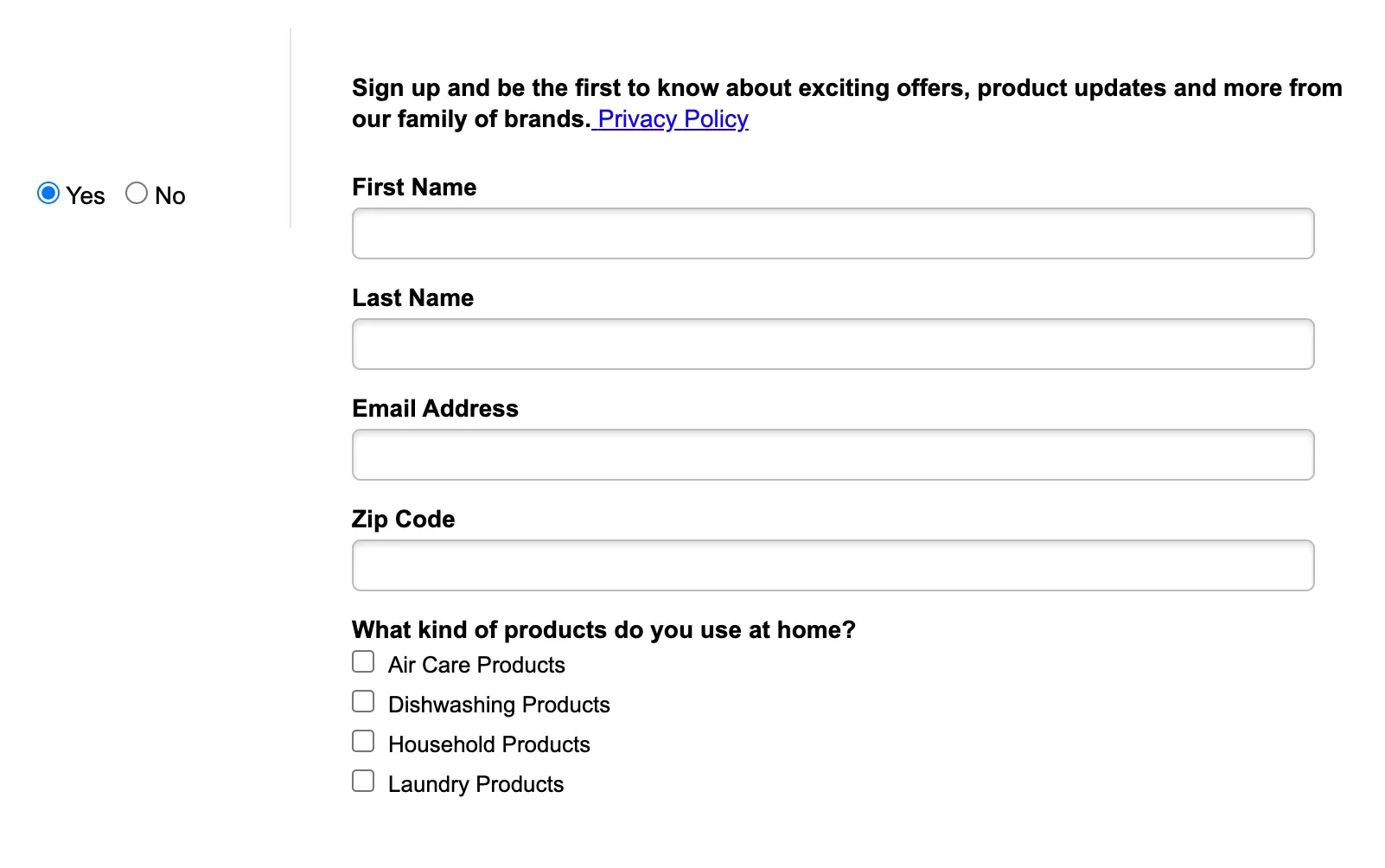
It’s not required that you add custom questions; in fact, we often dedicate a portion of the budget to test custom questions vs. no custom questions to determine if it increases engagement with subscribers.
If you do add custom questions, here’s a big reason to be judicious: lengthy opt-ins create more opportunities for subscribers to drop off and not complete the opt-in process, which generally produces either fewer conversions or less accurate data. And we always recommend against free-form, open-box fields; those entries are highly variable, which makes it hard to streamline the data for usable insights.
Overall, we recommend using progressive profiling to determine key insights about subscribers and segment them accordingly. Because progressive profiling is more reactive and nimble, the insights they produce are generally more accurate and valuable than the insights from asking a fixed custom question.
User engagement – goal definition and alignment
It’s a time to tread cautiously in email marketing; between the 2024 Gmail spam updates, iOS 15’s lingering impact on blurring actual open rates, and iOS 18’s shuffling of the Apple Mail inbox, deliverability is trickier – and more critical – than ever.
Our first step in helping our clients stay within spam thresholds for new users is goal definition. Typically for each pilot campaign we focus our efforts on early engagement rather than getting too aggressive and setting ourselves up to fail right into spam folders. We only shift to downstream engagement metrics once we have a decent sample size of data to support the decision.
For early engagement KPIs, we consider: open rate, clicker rate, and active rate (which is the percentage of subscribers that have opened at least 1 or more messages, divided by the number of new subscribers).
For downstream engagement KPIs, we consider: Open 2+ (users who have opened at least 2 emails), CAC, and ROI – but again, we only shift focus to those KPIs once early engagement data merits it.
These four steps are in place before we turn on the user-acquisition spigot. In subsequent posts, I’ll talk about DMi’s approach to user acquisition campaign optimization – and how we structure the email campaigns that blow away engagement benchmarks for those new users.
DMi Partners is a full-service digital marketing agency headquartered in Philadelphia. DMi has excelled in managing award-winning campaigns for recognized consumer, B2B and ecommerce brands since 2003. Its innovative email and affiliate management accompany an arsenal of digital services including SEO, paid search, ecommerce, branding and interactive, social media marketing and advanced marketing analytics designed to engage target audiences to drive revenue.
Staffed by big agency talent and offering the personal attention and agility of a boutique, DMi has a proven track record of delivering the highest quality marketing strategy, execution and results. Learn more by visiting dmipartners.com or contact info@dmipartners.com.

opens contact form
opens in a new tab
toggles visibility of form to submit resume
remove added file
